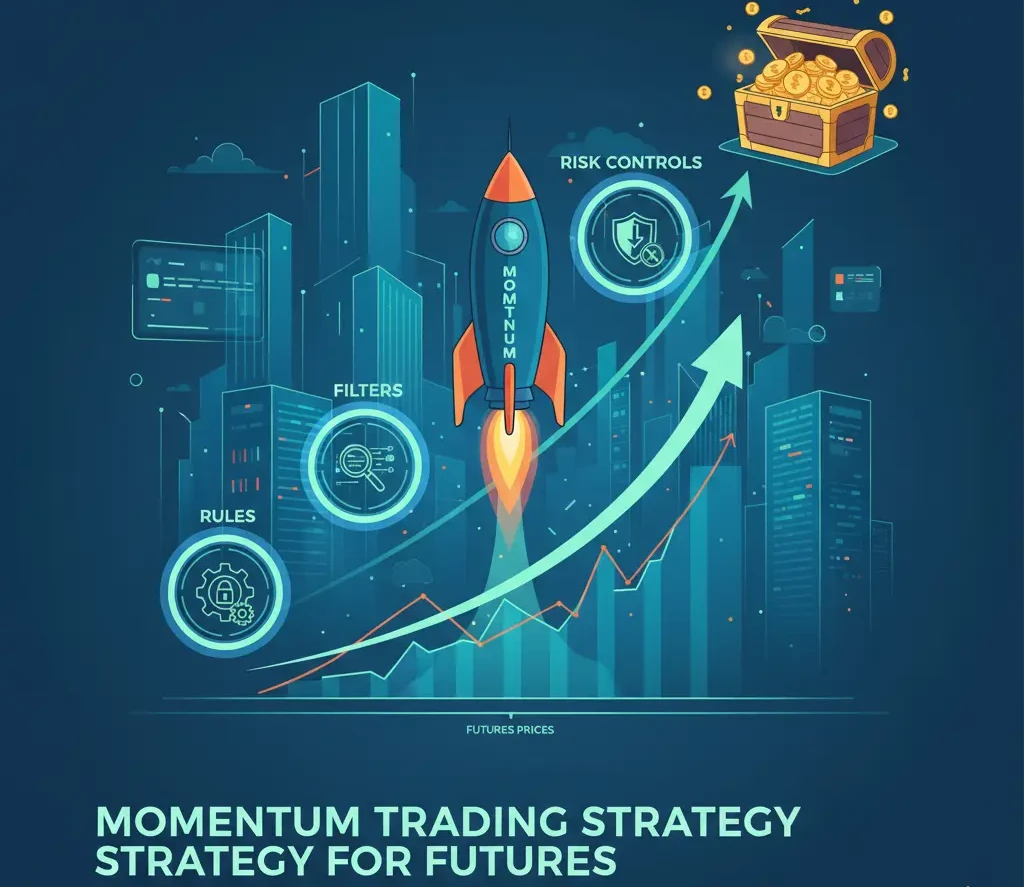
Momentum Trading for Futures: Rules, Filters, and Risk Controls
Introduction: Harnessing Market Velocity
In the fast-paced world of futures trading, momentum is the force that drives significant price movements. Traders who can successfully identify and ride these waves of market energy position themselves for substantial opportunities. However, harnessing this power requires more than just chasing price; it demands a disciplined approach. This guide delves into the core of momentum trading strategies, providing a structured framework of rules, filters, and risk controls designed for beginner, intermediate, and advanced traders. We will explore how to move beyond basic concepts to build a robust system that can adapt to ever-changing market conditions. The key lies in understanding not just when to enter, but more importantly, when to stay out and how to protect your capital when a trend inevitably reverses.
1. What Are Momentum Trading Strategies?
Momentum trading is a strategy that aims to capitalize on the continuation of existing market trends. The core principle is straightforward: assets that have been performing well are likely to continue performing well, and vice-versa. Unlike value investing, which seeks to buy undervalued assets, momentum trading is about « buying high and selling higher. » It operates on the psychological premise that strong price movements, often fueled by news, earnings reports, or shifts in market sentiment, attract more participants, further strengthening the trend. In futures markets, this is particularly potent due to the high liquidity and leverage available. A trader using a momentum trading strategy identifies an asset with a strong directional price move, enters a position in the same direction, and holds it until signs of reversal appear. Success hinges on precise timing, the ability to filter out false signals, and rigorous risk management to handle the inherent volatility. It’s less about fundamental value and more about the raw dynamics of supply and demand reflected in price action and volume.
2. Step-by-Step Guide for Beginners
For traders new to futures, momentum can be an intuitive starting point. The goal is to keep it simple and focus on execution and risk. A beginner’s approach should be systematic and rules-based to build discipline.
- Choose a Liquid Market: Start with highly liquid futures contracts like the E-mini S&P 500 (ES) or Micro E-minis. Their high volume ensures smooth order execution and reduces slippage.
- Define the Trend: Use a simple tool like a 50-period moving average (MA) on a 15-minute or 1-hour chart. If the price is consistently above the 50 MA, the primary trend is up. If below, it’s down. Only look for trades in the direction of this primary trend.
- Identify an Entry Signal: A common beginner signal is a « breakout. » A breakout occurs when the price moves above a recent high in an uptrend or below a recent low in a downtrend. Mark these key levels and wait for a clear, decisive price move through them.
- Confirm with Volume: A true momentum move is backed by increasing volume. When your breakout occurs, check the volume bar. It should be noticeably higher than the preceding bars, confirming conviction behind the move.
- Set Your Risk Before Entering: This is the most critical step. Place a stop-loss order immediately. A logical place is just below the breakout level for a long trade or just above it for a short trade. Never risk more than 1-2% of your trading capital on a single trade.
- Plan Your Exit: Have a pre-defined profit target. A simple method is to aim for a risk/reward ratio of 1:1.5 or 1:2. If you risked 10 points on a trade, your target should be 15 or 20 points away. This ensures your winners are larger than your losers. For more on structuring trades, explore our guide on Volume Profile Analysis in Futures.
3. Advanced Filters for Intermediate Traders
Once you’ve mastered the basics, the next step is to improve trade quality by adding filters. Filters help you avoid low-probability setups and choppy market conditions, which are the primary account-killers for momentum traders. An intermediate trader should focus on adding confluence to their signals.
Filter 1: Volatility Confirmation
Momentum thrives on volatility but dies in random chop. Use the Average True Range (ATR) indicator to gauge market volatility. If the ATR is flatlining or extremely low, it signals a quiet market where breakout attempts are likely to fail. Conversely, an excessively high ATR can indicate chaotic conditions where stop-losses are easily hit. Focus on trading when the ATR is rising steadily, suggesting a healthy, trending environment. This is a key part of an effective breakout trading strategy.
Filter 2: Higher Timeframe Alignment
Never trade in a vacuum. A strong momentum signal on a 5-minute chart is much more powerful if it aligns with the trend on the 1-hour and daily charts. Before entering a trade, check the higher timeframes. If you see a bullish breakout on your trading chart, but the daily chart is in a clear downtrend, the probability of failure is significantly higher. Only take trades that are in harmony with the larger market direction.
Filter 3: Indicator Confirmation
Use a secondary momentum indicator to confirm your primary signal. For example, if your entry is based on a price breakout, check the Relative Strength Index (RSI). A breakout to new highs should ideally be accompanied by the RSI also making new highs. If the RSI is showing a lower high (a bearish divergence), it’s a red flag that momentum is weakening, and the breakout may be a trap. This confirmation adds a layer of confidence to your trade. According to the CFTC’s Futures Trading Basics Guide, understanding such technical relationships is vital.
4. Quantitative Approaches for Advanced Traders
Advanced traders move from discretionary signal-following to systematic, data-driven approaches. This involves quantifying momentum and building strategies that can be backtested and optimized. The goal is to remove emotional decision-making and exploit statistical edges.
Rate of Change (ROC) Models
Instead of relying solely on visual breakouts, use the Rate of Change (ROC) indicator to create a quantitative filter. For example, a rule could be: « Only initiate long trades in the ES futures if the 10-day ROC is positive and the 50-day ROC is also positive. » This ensures you are trading in alignment with both short-term and medium-term momentum. You can further refine this by requiring the ROC to be above a certain threshold (e.g., > 2%) to filter for only the strongest trends.
Developing a Ranking System
For traders who scan multiple futures markets (e.g., indices, commodities, currencies), a ranking system is essential. Each day or week, you can score each market based on a combination of momentum metrics:
- Metric 1: 3-month total return.
- Metric 2: Proximity to its 52-week high.
- Metric 3: Current price relative to its 200-day moving average.
5. Essential Tools and Platform Setup
Effective momentum trading relies on the right tools and a streamlined platform setup. Your trading station should be designed for speed, clarity, and decisive action. The primary requirement is a robust charting platform like NinjaTrader or TradingView, which offers advanced indicators and fast order execution.
Core Platform Components:
- Advanced Charting: Your platform must support multiple timeframes, custom indicators (like ATR, RSI, MACD), and drawing tools to mark support and resistance levels.
- Level II Data (DOM): For short-term momentum trading, seeing the order book via a Depth of Market (DOM) is crucial. It helps you see buying and selling pressure in real-time and anticipate breakouts as large orders are filled.
- One-Click Order Entry: Momentum can be fleeting. You need the ability to enter and exit trades instantly. Configure your platform for one-click trading directly from the chart or DOM.
- Alerts and Scanners: Set up alerts for when a market breaks a key price level or when an indicator crosses a certain threshold. Market scanners can automatically search for futures contracts that meet your predefined momentum criteria, saving valuable time.
A well-configured workspace allows you to process information quickly and execute trades flawlessly, which is a significant edge in futures market analysis.
6. Strategy Examples in Futures Markets
Let’s apply these concepts to real-world futures contracts. Different markets have unique personalities, requiring slight adjustments to the core strategy.
Example 1: E-mini S&P 500 (ES) Breakout
The ES is known for its strong trends during the U.S. session. A common strategy involves waiting for the initial hour of trading to establish a range.
- Setup: Mark the high and low of the first 60 minutes of the RTH session (9:30-10:30 AM ET).
- Entry: Enter a long position if price breaks above the high with a surge in volume. Enter short if it breaks below the low.
- Pros: This strategy captures the primary trend of the day. It is a classic trend following futures approach.
- Cons: Prone to false breakouts, especially on low-volume days. A higher timeframe filter is essential.
Example 2: Crude Oil (CL) News-Driven Momentum
Crude Oil is highly sensitive to geopolitical news and weekly inventory reports.
- Setup: Be prepared around key news releases (like the EIA report). Do not trade just before the release.
- Entry: After the news, wait for a clear 5-minute candle to close. If it’s a strong bullish close, enter long with a stop below the candle’s low.
- Pros: Can produce extremely fast and powerful moves.
- Cons: High risk and extreme volatility. Requires wider stops and smaller position sizes. Slippage can be significant. This is where advanced order flow analysis becomes invaluable.
7. Risk Management and Common Mistakes
More traders fail due to poor risk management than poor strategy. Momentum trading, with its fast moves and sharp reversals, is particularly unforgiving of sloppy risk controls.
The Golden Rules of Risk Control:
- Always Use a Hard Stop-Loss: This is non-negotiable. A hard stop-loss is an order placed in the market that automatically closes your position at a specific price. Mental stops do not work.
- The 1% Rule: Never risk more than 1% of your total trading account on a single trade. This allows you to withstand a string of losses without blowing up your account.
- Position Sizing: Your position size should be determined by your stop-loss distance, not the other way around. Calculate how many contracts you can trade based on your 1% risk rule and the distance from your entry to your stop.
Common Mistakes to Avoid:
- Chasing Price: Entering a trade late after the move has already happened. This leads to poor entry prices and wide stops.
- Ignoring Market Context: Trading a momentum signal without considering the overall market environment (e.g., trying to long breakouts in a bear market).
- Failing to Take Profits: Letting a winning trade turn into a loser because of greed. Always have a profit target or a trailing stop strategy. For more details on avoiding common pitfalls, see our article on maintaining trading discipline.
8. Comparison of Momentum Indicators
Different indicators measure momentum in unique ways. Choosing the right one depends on your trading style and the market you’re trading. Here is a comparison of three popular momentum indicators.
| Indicator | How It Works | Best For | Potential Weakness |
|---|---|---|---|
| Relative Strength Index (RSI) | Measures the speed and change of price movements on a scale of 0 to 100. Identifies overbought (>70) and oversold (<30) conditions. | Identifying potential trend exhaustion and reversals. Useful for finding pullback entries in a strong trend. | Can give false signals in strongly trending markets, staying « overbought » or « oversold » for long periods. |
| Moving Average Convergence Divergence (MACD) | Shows the relationship between two exponential moving averages. A crossover of the MACD line and signal line indicates a change in momentum. | Confirming the direction and strength of a new trend. The histogram is excellent for visualizing accelerating or decelerating momentum. | It is a lagging indicator, meaning it can be slow to signal entries and exits, potentially missing the initial part of a move. |
| Stochastic Oscillator | Compares a security’s closing price to its price range over a given time period. Similar to RSI, it identifies overbought (>80) and oversold (<20) levels. | Finding entry points in range-bound or consolidating markets. Works well for short-term « mean reversion » plays within a larger trend. | Not well-suited for strongly trending markets, as it will frequently generate premature reversal signals. |
9. Visual Analysis: Momentum vs. Volatility
Understanding the relationship between momentum and volatility is key. High momentum requires volatility to exist, but not all volatility leads to tradable momentum. The chart below illustrates this concept.
The best trading opportunities, labeled « Ideal Trend » and « Breakout Phase, » occur when a rise in volatility is matched by a strong, directional rise in momentum. In contrast, the « Choppy Market » phase shows volatility without clear direction, a dangerous environment for trend-followers. Learning to distinguish these phases is a critical skill acquired through experience and careful futures market analysis. For in-depth training on these concepts, resources from reputable exchanges like the CME Group’s Education Hub are invaluable.
10. Key Takeaways
- Discipline is Paramount: A successful momentum trading strategy is built on a foundation of strict rules for entries, exits, and risk management.
- Context is King: Always analyze momentum signals within the context of higher timeframe trends and market volatility. A signal in isolation is unreliable.
- Volume is Confirmation: True momentum is backed by high participation. A price move on low volume is often a trap.
- Start Simple, Then Filter: Beginners should master a basic breakout system. Intermediate traders can improve performance by adding volatility and trend alignment filters.
- Risk Controls Protect Capital: The aggressive nature of momentum trading necessitates non-negotiable risk controls, including hard stop-losses and proper position sizing.
- Adapt to the Market: The tools and strategies that work in a trending market like Crude Oil may differ from those for a range-bound currency future.
11. Frequently Asked Questions
- What is the best indicator for momentum trading?
- There is no single ‘best’ indicator. Many traders use a combination, such as the Relative Strength Index (RSI) to identify overbought/oversold conditions and Moving Average Convergence Divergence (MACD) to confirm trend direction and strength. The best setup depends on the market, timeframe, and trader’s personal style.
- How do you filter for high-probability momentum trades?
- Effective filters include confirming volume, market volatility, and alignment with the broader market trend. For example, a trader might only take long momentum signals in an equity index future if the underlying stock market is also in a clear uptrend. Using a volatility filter like the Average True Range (ATR) can also help avoid choppy, low-momentum environments.
- Can beginners use momentum trading strategies?
- Yes, beginners can use momentum strategies due to their relatively clear entry and exit signals. However, it is crucial for beginners to start on a simulator, master one or two specific setups, and apply strict risk management rules, such as a fixed stop-loss and a clear profit target, to avoid large losses from sudden reversals.
- What is a momentum crash?
- A momentum crash is a sudden, sharp reversal of a strong trend, which can lead to significant losses for momentum traders who are positioned in the direction of the trend. These events are often triggered by unexpected news or a rapid shift in market sentiment and highlight the critical importance of using stop-loss orders.
- How does liquidity affect momentum trading in futures?
- High liquidity is essential for momentum trading. It ensures that traders can enter and exit positions quickly with minimal slippage (the difference between the expected and executed price). In illiquid markets, a large order can disproportionately move the price, making it difficult to execute a momentum strategy effectively.
12. Conclusion
Momentum trading offers a powerful way to engage with the futures markets, but it is a double-edged sword. The same velocity that creates incredible opportunities can also lead to rapid losses if not managed with discipline. By building a systematic approach that layers clear rules, intelligent filters, and unwavering risk controls, traders at all levels can learn to harness the power of market trends. Whether you are a beginner defining your first breakout rule or an advanced trader building quantitative models, the principles remain the same: identify the trend, confirm its strength, manage your risk, and execute with precision. The journey to mastering momentum is a marathon, not a sprint, and is built on a foundation of continuous learning and adaptation.