Futures Trading 101: A Beginner’s Guide to Contracts, Margin, and Leverage
Diving into the world of financial markets can be intimidating, but futures trading for beginners doesn’t have to be a mystery. This guide is designed to demystify the three pillars of futures: contracts, margin, and leverage. Unlike buying stocks, futures trading involves standardized agreements to buy or sell an asset at a future date, without needing the full capital upfront. Instead, you use a good-faith deposit called margin. This system introduces leverage, a powerful tool that allows you to control a large contract value with a relatively small amount of capital. Understanding how these components interact is the first critical step toward building a solid trading foundation and navigating the opportunities and risks inherent in the futures markets.
What Are Futures Contracts? The Core Concept
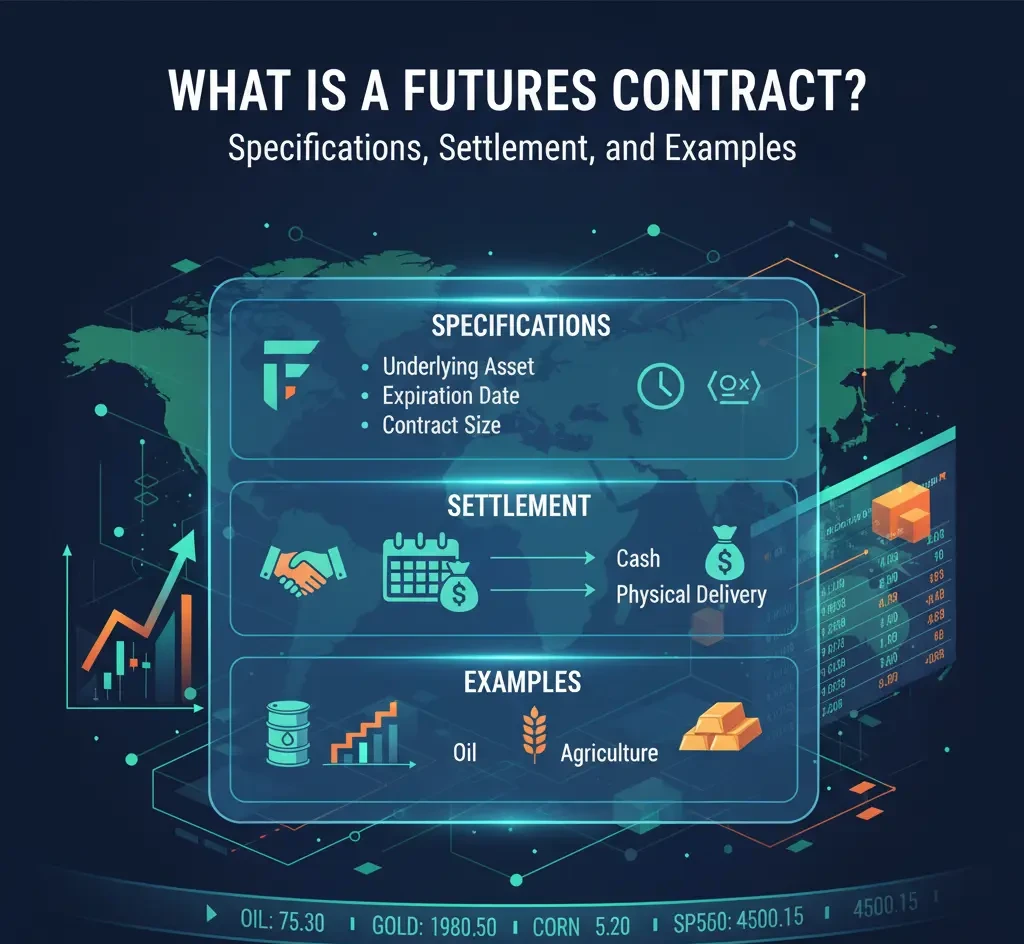
A futures contract is a standardized legal agreement to buy or sell a particular commodity or financial instrument at a predetermined price at a specified time in the future. These contracts are traded on regulated exchanges, which ensures transparency and standardization. Each contract specifies the asset, quantity, quality, and delivery date.
For example, an E-mini S&P 500 futures contract (ticker: ES) gives you exposure to the 500 largest U.S. stocks. You aren’t buying 500 individual stocks; you are trading a single contract whose value is derived from the index’s performance. Other common futures contracts are based on:
- Equity Indexes: E-mini S&P 500, Nasdaq 100
- Commodities: Crude Oil, Gold, Corn, Soybeans
- Currencies: Euro, Japanese Yen
- Interest Rates: Treasury Bonds
The key takeaway is that futures were originally created for producers and consumers to hedge against price fluctuations. Today, speculators play a vital role by providing liquidity, betting on the future direction of these prices without intending to take physical delivery of the underlying asset. For a foundational overview, the CFTC provides excellent « Futures 101 » material for new traders.
Understanding Margin: Your Good-Faith Deposit
When it comes to futures trading for beginners, the concept of margin is often misunderstood. Unlike in stock trading where margin means borrowing money, in futures, it is a performance bond or a good-faith deposit. It’s the amount of capital you must have in your account to open and maintain a position. This is not a down payment, and you do not own the underlying asset. There are two primary types of margin:
Initial Margin
This is the amount required by the exchange to initiate a futures position. It is a fraction of the total contract value. For instance, a crude oil futures contract might control $75,000 worth of oil, but the initial margin to trade it could be around $5,000. This requirement is set by the exchange and can vary based on the contract’s volatility.
Maintenance Margin
This is the minimum amount of equity that must be maintained in your account to hold your position. It is typically slightly lower than the initial margin. If losses from your trade cause your account balance to fall below the maintenance margin level, you’ll receive a « margin call » from your broker, requiring you to deposit more funds to bring your account back up to the initial margin level. Failure to do so will result in your broker liquidating your position. This mechanism protects the brokerage and the exchange from default risk.
Exploring futures trading basics further will help you understand how these margin requirements are applied in real-time by your broker.
Leverage: The Double-Edged Sword of Futures
Leverage is the defining feature of futures trading. Because the margin required is only a small percentage of the contract’s total value, you can control a large position with a relatively small amount of capital. This is what’s known as leverage. For example, if a futures contract has a notional value of $100,000 and requires an initial margin of $5,000, you have a leverage ratio of 20:1. This means for every $1 you put up, you control $20 worth of the underlying asset.
The power of leverage is that it can amplify your returns significantly. A small positive price movement can result in a large percentage gain on your margin capital. However, the reverse is also true and is a critical risk for anyone starting with futures trading for beginners. A small adverse price movement can result in substantial losses, potentially exceeding your initial deposit. Many algorithmic trading strategies are designed specifically to manage this leverage risk through automated stop-losses and position sizing.
As a beginner, it is crucial to respect leverage and start with smaller position sizes or micro contracts until you are comfortable with the dynamics. Reputable platforms like NinjaTrader offer detailed guides on how margin and leverage are calculated on their platform.
Futures vs. Stocks: A Core Comparison
For beginners, understanding the difference between futures and the more familiar stock market is crucial. While both involve speculating on price, their mechanics and risk profiles are fundamentally different.
| Feature | Futures Trading | Stock Trading |
|---|---|---|
| Asset Control | Control a standardized contract for a future date. No ownership of the underlying asset. | Direct ownership of a share (equity) in a company. |
| Leverage | Highly leveraged; margin is a small percentage of the contract’s value (e.g., 3-12%). | Limited leverage; Regulation T limits borrowing to 50% of the stock’s value. |
| Market Hours | Often trade nearly 24 hours a day, 5 days a week. | Typically limited to specific exchange hours (e.g., 9:30 AM to 4:00 PM ET). |
| Expiration | Contracts have specific expiration dates, requiring you to close or roll over your position. | No expiration; you can hold shares indefinitely. |
| Regulation | Regulated by the Commodity Futures Trading Commission (CFTC). | Regulated by the Securities and Exchange Commission (SEC). |
Key Risks and How to Manage Them
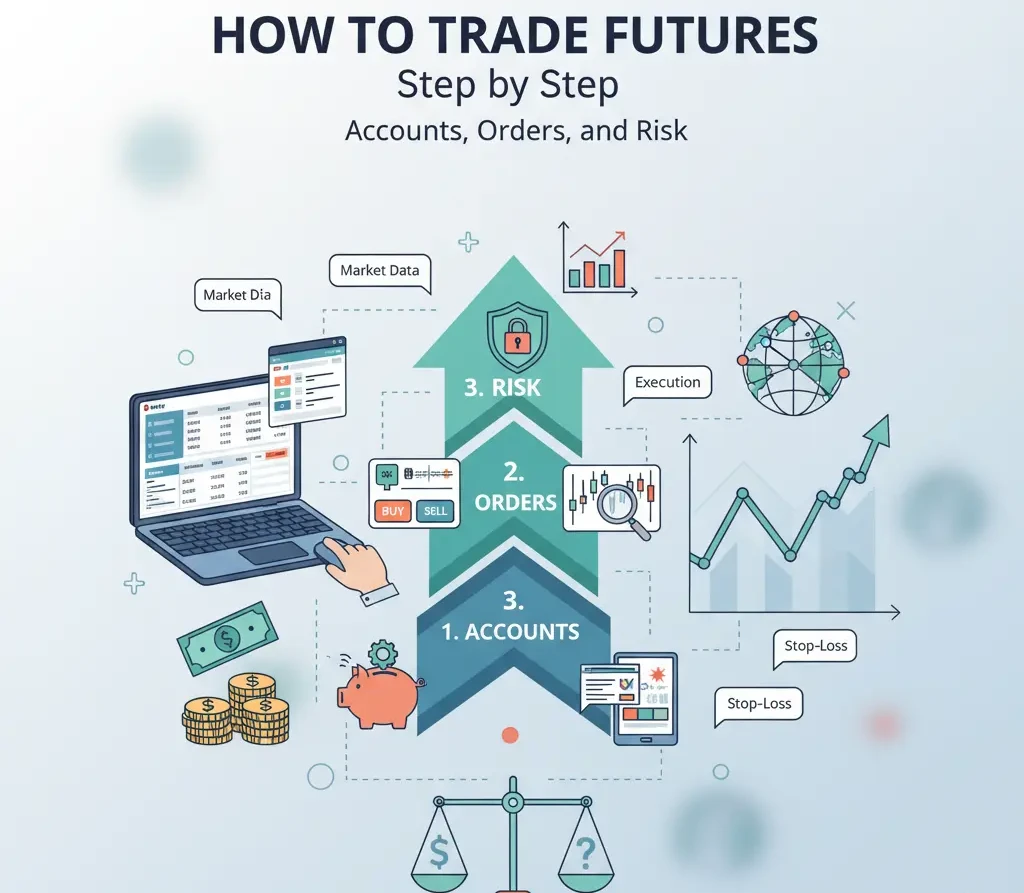
The high degree of leverage in futures trading means that risk management is paramount. Without a disciplined approach, a beginner can quickly lose their trading capital. Here are the primary risks and foundational strategies to mitigate them:
Leverage Risk
As discussed, leverage magnifies losses just as it does gains. A small market move against your position can trigger a margin call or wipe out your account.
Mitigation:
- Use Stop-Loss Orders: Always trade with a pre-defined exit point for a losing trade.
- Position Sizing: Risk only a small percentage (e.g., 1-2%) of your trading capital on any single trade.
- Trade Micro Contracts: Start with smaller « micro » contracts (like MES instead of ES) which represent a fraction of the value and risk.
To visualize risk, consider a simple meter. A highly leveraged position in a volatile market would be in the high-risk zone.
Risk Level:
Market Risk
Unexpected news, economic data releases, or geopolitical events can cause rapid and unpredictable price swings (volatility).
Mitigation:
- Stay Informed: Be aware of major economic events on the calendar.
- Avoid Trading Around News: Beginners should consider staying out of the market during major news releases until they have more experience.
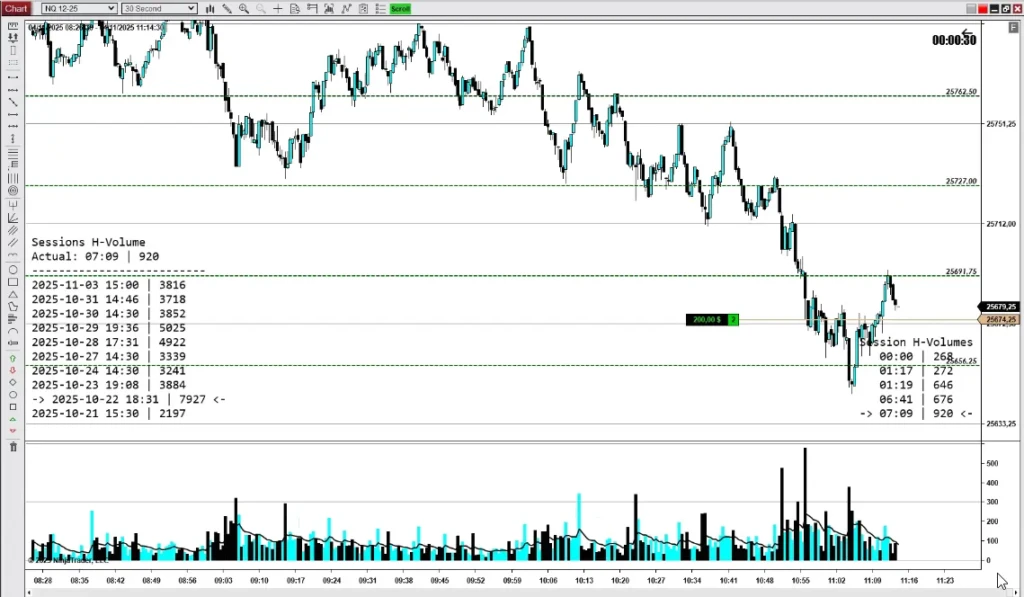
- Analyze with Tools: Understanding market structure using tools like Volume Profile in futures can provide context on key support and resistance levels.
Visual Insights: Volatility by Trading Session
Different futures contracts exhibit varying levels of volatility and volume depending on the time of day, which corresponds to the overlap of global trading sessions. Understanding this can help you choose when to trade. The chart below illustrates a hypothetical average volatility for a US equity index future like the E-mini S&P 500.
As the chart shows, the highest volatility and volume typically occur during the overlap of the London and New York sessions, offering the most trading opportunities but also the highest risk. The Asian session is generally the calmest.
Frequently Asked Questions (FAQ)
What is the minimum capital to start futures trading?
The minimum capital varies by broker and contract, but it’s determined by the initial margin requirement. Day trading margins can be as low as $50 for some micro contracts, while standard contracts like the E-mini S&P 500 can require several thousand dollars. It’s crucial to have more than the bare minimum to manage risk and avoid immediate margin calls.
Can you lose more than you invest in futures?
Yes, it is possible to lose more than your initial investment (the margin posted) when trading futures. The high degree of leverage means that adverse price movements can lead to losses that exceed your account balance, and you would be responsible for covering that deficit.
What happens if my account falls below the maintenance margin?
If your account equity drops below the maintenance margin level, you will receive a ‘margin call’ from your broker. This requires you to deposit additional funds to bring your account back up to the initial margin level. If you fail to meet the margin call, your broker has the right to liquidate your position to prevent further losses.
Conclusion: Your Next Steps in Futures Trading
You now have a foundational understanding of the core concepts in futures trading for beginners: contracts define what you trade, margin is your entry ticket, and leverage is the power that drives potential outcomes. The key to longevity is respecting the inherent risks, especially those associated with leverage. Start with a solid education, practice in a simulated environment, and always prioritize risk management.
As you become more comfortable, the next logical step is to explore different trading approaches. To learn more about how to get started on the right foot, we recommend reading our comprehensive guide on Futures Trading Basics.