Best Futures Trading Strategies in 2026: Momentum, Mean Reversion, and Breakouts
Navigating the dynamic world of futures requires a robust and well-defined plan. For traders aiming for success in 2026, identifying the best futures trading strategies that align with their personality and risk tolerance is the first critical step. Without a clear methodology, traders are simply gambling. This guide provides a detailed breakdown of three timeless and effective approaches: momentum, mean reversion, and breakout trading, tailored for beginner, intermediate, and advanced traders.
Whether you are looking to ride powerful trends, capitalize on price extremes, or trade explosive moves from consolidation, understanding the mechanics of these core strategies is essential. We will explore the what, why, and how of each, enabling you to build a more resilient and adaptable trading plan for the markets ahead.
What Are Futures Trading Strategies? A Primer
A futures trading strategy is a comprehensive set of rules that dictates a trader’s actions, from entry to exit. It’s a structured approach designed to remove emotion and guesswork from trading decisions. For beginners, a strategy provides a necessary framework. For advanced traders, it’s a refined system that has been tested and proven over time. The core components of any effective strategy include market selection (e.g., ES, NQ, CL), specific entry triggers, predefined stop-loss placement for risk control, and clear profit targets.
The goal is to find a methodology with a positive expectancy—meaning, over a large number of trades, it is expected to generate more profit than loss. The best futures trading strategies are not about winning every trade; they are about disciplined execution and sound risk management. As defined by the CFTC’s Futures Trading Basics Guide, understanding the underlying principles of these markets is the foundation upon which all successful strategies are built. Without this knowledge, even the most sophisticated plan is likely to fail.
The Momentum Strategy: Riding the Market’s Trend
Momentum trading is built on the principle that an asset in motion tends to stay in motion. Traders using this approach identify instruments showing a strong directional move and enter in the same direction, aiming to capture a significant portion of the trend. This is one of the most popular day trading futures strategies because intraday trends can be powerful and clear.
A Step-by-Step Guide to Momentum Trading:
- Identify the Primary Trend: Use tools like moving averages (e.g., 50 EMA and 200 EMA) on a higher timeframe (like a 60-minute chart) to determine the overall market direction. Only look for long trades in an uptrend and short trades in a downtrend.
- Wait for a Pullback: The best entries often occur during minor pullbacks to a key support level or moving average. Entering on a pullback offers a better risk-to-reward ratio than chasing a peak.
- Confirm Entry with an Indicator: Use an oscillator like the Relative Strength Index (RSI) or a volume indicator to confirm the trend is likely to resume. A surge in volume on the entry candle is a strong confirmation signal. Our guide on Volume Profile Analysis in Futures can provide deeper insights here.
- Set Stop-Loss and Targets: Place your stop-loss just below the recent swing low (for a long trade) or above the swing high (for a short trade). Profit targets can be set at the next key resistance level or by using a trailing stop to maximize gains.
This approach requires discipline to avoid chasing parabolic moves and patience to wait for optimal entry points. It works best in trending market conditions and can lead to significant losses during choppy, range-bound periods.
The Mean Reversion Strategy: Fading the Extremes
Mean reversion is the opposite of momentum. This strategy operates on the theory that prices, after reaching an extreme high or low, tend to revert to their historical average or « mean. » It’s a contrarian approach that involves selling into strength and buying into weakness. Traders using mean reversion futures strategies look for signs of exhaustion in a trend and position themselves for the reversal.
This style suits patient traders who are comfortable trading against the prevailing short-term sentiment. It requires precise timing and a deep understanding of overbought and oversold conditions.
Executing a Mean Reversion Trade:
- Identify an Extreme: Use indicators like Bollinger Bands or Keltner Channels. A price move that extends far outside the upper or lower bands can signal an unsustainable extreme.
- Look for Divergence: Check for bearish or bullish divergence on an oscillator like the RSI or MACD. For example, if the price makes a new high but the RSI makes a lower high, it signals weakening momentum and a potential reversal.
- Pinpoint the Entry: Wait for a reversal candlestick pattern, such as a pin bar or an engulfing candle, to confirm that the price is beginning to turn. This is the entry trigger.
- Manage the Trade: Place a tight stop-loss just beyond the extreme point of the move. The profit target is typically the moving average or the middle of the Bollinger Band, which represents the « mean. »
The Breakout Strategy: Trading Key Price Levels
A breakout strategy involves identifying key levels of support and resistance and entering a trade when the price decisively breaks through one of them. The idea is that the break of a significant level will attract a rush of new buyers or sellers, propelling the price further in the direction of the breakout. This is a classic futures trading strategy that can be applied to any timeframe.
Success with a breakout strategy futures approach hinges on two things: correctly identifying significant levels and avoiding « false breakouts, » where the price briefly breaks a level only to reverse. Volume is a critical confirmation tool here; a genuine breakout should be accompanied by a significant increase in trading volume. Traders often study the nuances of Order Flow Trading to better differentiate real from fake breakouts.
How to Trade a Breakout:
- Draw Key Levels: Analyze the chart to identify clear and respected support and resistance levels where the price has reacted multiple times.
- Monitor for a Break: Watch for a candle to close convincingly above resistance (for a long entry) or below support (for a short entry).
- Confirm with Volume: Ensure the breakout candle is supported by a spike in volume. This indicates strong conviction behind the move.
- Enter and Set Stops: Enter on the close of the breakout candle or on a retest of the broken level. The stop-loss is placed on the opposite side of the breakout level.
Comparing the Top 3 Futures Trading Strategies
Choosing the right strategy depends on market conditions and your trading personality. No single approach is superior in all scenarios. The table below provides a high-level comparison to help you decide which of these best futures trading strategies might suit you.
| Criterion | Momentum Strategy | Mean Reversion Strategy | Breakout Strategy |
|---|---|---|---|
| Optimal Market | Trending (strong uptrends or downtrends) | Ranging or Channeling | Consolidating, then Volatile |
| Psychology | Trend-following, patient with winners | Contrarian, comfortable fading moves | Decisive, quick to act on signals |
| Win Rate | Lower to Moderate | Moderate to High | Lower to Moderate |
| Risk/Reward Ratio | Potentially High | Typically Lower | Potentially High |
| Primary Risk | Getting caught in a trend reversal | A trend continues against the position | False breakouts (« fakeouts ») |
Visualizing a Breakout: A Chart Analysis
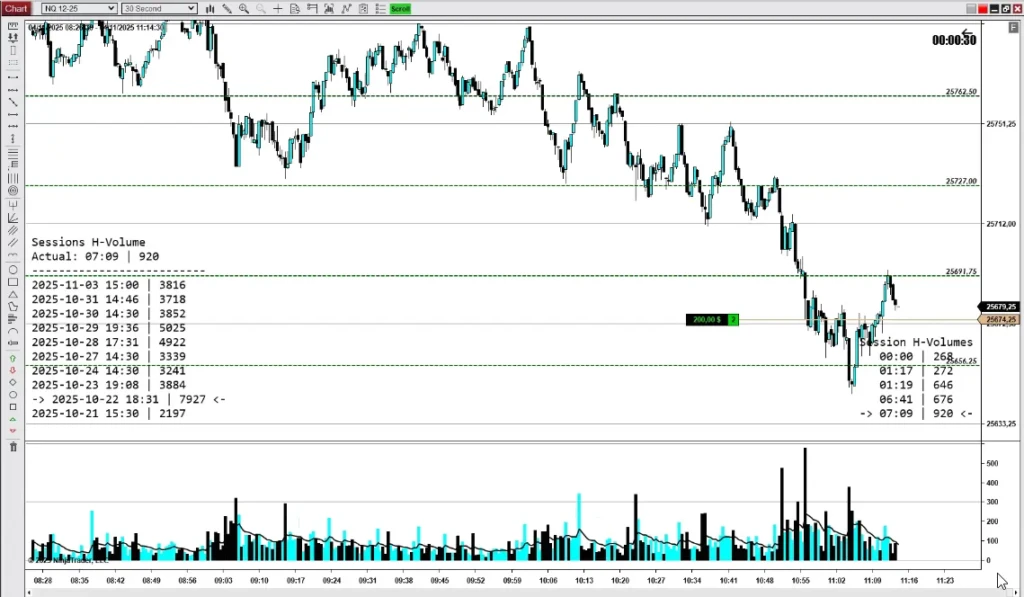
To better understand a breakout, let’s look at a visual representation. The chart below illustrates a classic resistance breakout scenario. Notice the period of consolidation, the key resistance level that holds multiple times, and the eventual break accompanied by an increase in volume, signaling a high-probability entry.
Essential Tools and Platform Setup
Executing any of these strategies effectively requires the right set of tools. Your success is not just about the strategy itself, but also the platform and data you use. For futures traders, a low-latency connection and a professional-grade platform are non-negotiable. Platforms like NinjaTrader or TradingView are popular choices, offering advanced charting, indicator sets, and order execution capabilities.
Essential components of your setup should include:
- A Reliable Charting Platform: Provides access to real-time data, technical indicators, and drawing tools needed to identify setups. The educational resources from sources like TradingView Education can be invaluable for learning to use these tools.
- A Reputable Futures Broker: Offers competitive commissions, stable connections, and the specific futures contracts you wish to trade.
- A Trading Journal: An often-overlooked tool, a journal is critical for tracking trades, reviewing performance, and refining your strategy over time.
A well-configured workspace, such as the one described in our NinjaTrader 8 Setup Guide, can significantly improve your efficiency and ability to execute trades without error.
Advanced Risk Management for Futures Traders
Even the best futures trading strategies will fail without disciplined risk management. The high leverage inherent in futures can amplify both gains and losses, making risk control the single most important skill for a trader’s survival. Your primary job as a trader is not to make money, but to protect the capital you have.
Advanced risk management goes beyond just setting a stop-loss. It involves a holistic approach to preserving capital:
- The 1% Rule: Never risk more than 1% of your trading capital on a single trade. This ensures that a string of losses will not wipe out your account, allowing you to stay in the game.
- Position Sizing: Calculate your position size based on your stop-loss distance and the 1% rule. Do not use a fixed number of contracts for every trade; adjust based on the trade’s specific volatility and risk.
- Understand Correlation: Be aware of how different futures markets are correlated. Being long both ES (S&P 500) and NQ (Nasdaq 100) is not two separate risks; it’s a concentrated bet on the stock market moving higher.
- Daily Loss Limits: Set a maximum amount of money you are willing to lose in a single day. If you hit that limit, you shut down your platform and walk away. This prevents « revenge trading » and catastrophic losses.
The CME Group’s Risk Management Courses offer excellent resources for traders looking to deepen their understanding of these professional-grade risk control techniques.
Key Takeaways for Your 2026 Trading Plan
As you prepare your trading approach for 2026, keep these core principles in mind:
- No Holy Grail: There is no single « best » strategy. Success comes from mastering one or two strategies that fit your personality and the prevailing market conditions.
- Adaptability is Key: A strategy that works well in a trending market (momentum) may perform poorly in a ranging one. Be able to identify the market environment and apply the appropriate strategy.
- Risk First, Profit Second: Your long-term survival depends entirely on your risk management discipline. Protect your capital at all costs.
- Confirmation is Crucial: Always seek a secondary signal, like a volume spike or an indicator confirmation, before entering a trade to reduce the risk of false signals.
- Continuous Learning: The markets are always evolving. A commitment to continuous education and strategy refinement is essential for lasting success.
Frequently Asked Questions (FAQ)
What is the most consistently profitable futures trading strategy?
There is no single ‘most profitable’ strategy that works for everyone. Profitability depends on the trader’s skill, risk tolerance, market conditions, and discipline. The best futures trading strategies are those that a trader has backtested, understands deeply, and can execute consistently. Momentum, mean reversion, and breakout strategies all have the potential for profitability when applied correctly.
Can beginners use breakout strategies for day trading futures?
Yes, beginners can use breakout strategies, as the logic is relatively straightforward: enter when price breaks a key level. However, they must be cautious of ‘false breakouts.’ New traders should focus on high-probability setups, use tight stop-losses, and confirm breakouts with other indicators like a surge in volume. Paper trading is highly recommended to gain experience without financial risk.
How important is risk management in swing trading futures?
Risk management is paramount in swing trading futures, perhaps even more so than in day trading, because positions are held overnight, exposing traders to gap risk. Proper position sizing, setting a hard stop-loss on every trade, and understanding the contract’s leverage are non-negotiable rules for survival and long-term success.
Conclusion: Building Your Strategic Edge
The journey to becoming a consistently profitable futures trader is a marathon, not a sprint. The momentum, mean reversion, and breakout strategies discussed here are not just abstract theories; they are battle-tested frameworks used by traders worldwide. Your task is to study them, paper trade them extensively, and discover which one resonates most with your analytical style and psychological makeup.
By combining a well-understood strategy with iron-clad risk management and the right set of tools, you can build a formidable trading plan for 2026 and beyond. Start by mastering one setup, track your results, and build from there.