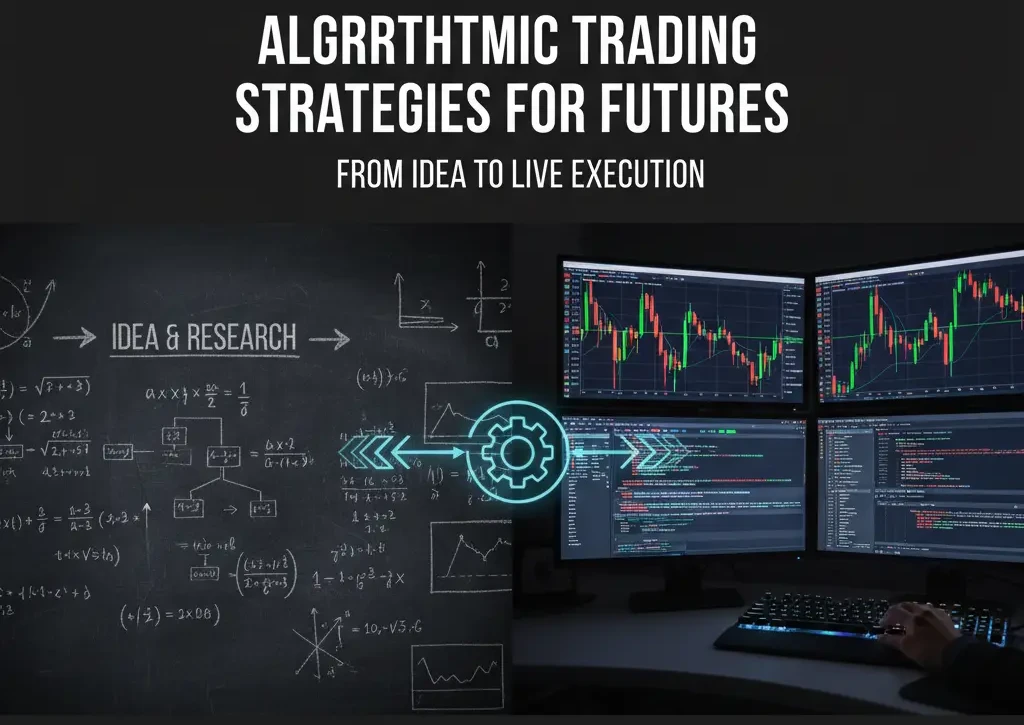
Algorithmic Trading Strategies for Futures: From Idea to Live Execution
Developing effective algorithmic trading strategies for the fast-paced futures market can seem like a monumental task, transitioning from a promising idea to a live, automated system. For traders at all levels—from beginners grappling with code to advanced quants refining complex models—the path is filled with challenges related to design, testing, and risk management. This guide demystifies the entire lifecycle, providing a structured framework to systematically build, validate, and deploy a robust futures trading algorithm. By understanding each phase, you can avoid common pitfalls and increase your chances of creating a durable, automated trading system. We will cover everything from initial concept and rigorous backtesting to final execution and ongoing performance monitoring.
What Are Algorithmic Trading Strategies?
At its core, algorithmic trading involves using computer programs to execute trades based on a predefined set of rules. These rules can be based on various inputs, including price, volume, timing, or complex mathematical models. The primary goal is to remove human emotion and error from the trading process, allowing for disciplined, high-speed, and systematic execution. For futures traders, this means an automated system can monitor multiple markets and execute orders faster than any human could, capitalizing on fleeting opportunities. A well-designed futures trading algorithm doesn’t just buy and sell; it incorporates rules for position sizing, risk management (like stop-losses), and profit targets, all operating without manual intervention. This systematic approach is crucial in leveraged markets where discipline is paramount. By codifying a trading plan, you create a process that is repeatable, testable, and scalable, transforming subjective ideas into objective, data-driven actions.
A Step-by-Step Guide to Developing Your Strategy
Building a successful trading bot is a methodical process that progresses from a simple idea to a complex, automated system. Rushing any step can lead to flawed logic and financial losses. Following a structured development path ensures every aspect of the strategy is thoroughly vetted before it ever touches real capital. This discipline separates sustainable algorithms from those that quickly fail.
- Idea Generation & Hypothesis: Start with a clear, testable hypothesis. For example: « Buying the E-mini S&P 500 (ES) when the 20-period moving average crosses above the 50-period moving average on a 15-minute chart, and volume is above average, will be profitable. » The idea should be specific and grounded in a market inefficiency you believe exists.
- Data Collection & Preparation: Acquire high-quality historical data for the futures contract you intend to trade. This data must be clean, accounting for contract rollovers, trading hours, and potential errors. For robust backtesting, you need enough data to cover various market conditions, including uptrends, downtrends, and sideways markets.
- Strategy Coding: Translate your hypothesis into code using a language like Python or a platform-specific language like NinjaScript. This is where you define your exact entry/exit rules, order types, and risk parameters. The code must be a precise reflection of your written rules to ensure the backtest is valid.
- Rigorous Backtesting & Validation: Backtesting is the process of simulating your strategy on historical data to evaluate its performance. Analyze key metrics like net profit, drawdown, and the Sharpe ratio. Crucially, you must avoid « overfitting, » where a strategy is tuned so perfectly to past data that it fails in live market conditions. Use out-of-sample data (a portion of data the model hasn’t seen) to validate its robustness.
- Forward Performance Testing (Paper Trading): Before going live, run your algorithm in a simulated environment with real-time data. This forward testing validates its performance in current market conditions and helps identify any issues with the code or its interaction with the broker’s API. This is the final check before risking real money.
Essential Tools & Platform Setup
The right technology stack is foundational to developing and deploying algorithmic trading strategies. Your choice of tools will impact everything from the complexity of the strategies you can build to the speed of their execution. For beginners, an all-in-one platform like NinjaTrader or TradeStation is often the best starting point, as they integrate charting, backtesting, and brokerage services. These platforms use proprietary languages (NinjaScript and EasyLanguage, respectively) that are relatively easy to learn. For intermediate and advanced traders seeking more flexibility, a Python-based setup is superior. Python’s powerful libraries—such as Pandas for data manipulation, NumPy for numerical analysis, and backtrader or Zipline for event-driven backtesting—offer limitless customization. To connect a custom Python script to a broker for live trading, you will need to use an Application Programming Interface (API). Many brokers, like Interactive Brokers, provide robust APIs for this purpose. Regardless of the path you choose, a reliable data feed is non-negotiable. For futures, this means getting data directly from the exchange (e.g., CME Group) to ensure accuracy for backtesting and live execution.
Core Strategy Examples for Futures Markets
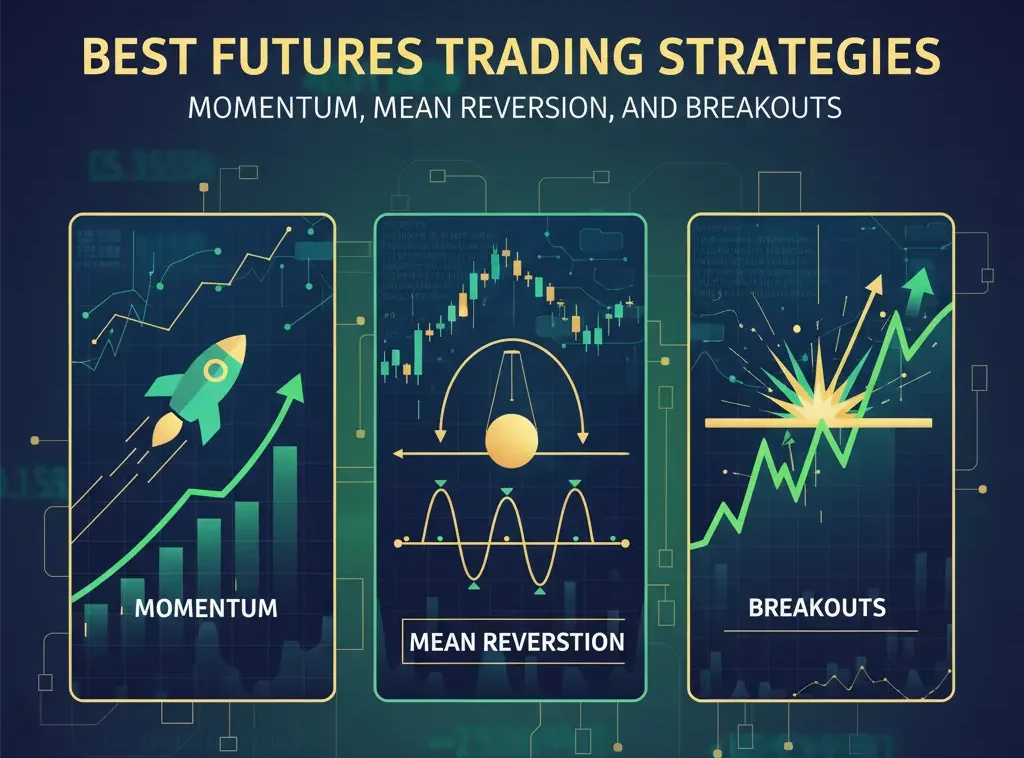
While algorithmic strategies can be infinitely complex, most are built upon a few core concepts. Understanding these foundational models provides a strong starting point for traders of all levels. Each has distinct advantages and is suited for different market conditions.
1. Trend-Following Strategy
This is one of the most common types of quantitative trading strategies. The algorithm is designed to identify the direction of the market trend and take a position in the same direction. A simple example involves using moving average crossovers. For instance, the system might generate a buy signal when a short-term moving average (e.g., 20-period) crosses above a long-term one (e.g., 50-period).
Pros: Can capture large, sustained market moves, leading to significant profits.
Cons: Performs poorly in range-bound or choppy markets, often resulting in numerous small losses (whipsaws).
2. Mean Reversion Strategy
This strategy is based on the statistical premise that prices will eventually revert to their historical average or mean. The algorithm identifies when a futures contract is trading at an extreme price relative to its recent history and takes a counter-trend position, betting on a return to the mean. Indicators like Bollinger Bands or the Relative Strength Index (RSI) are often used to identify these overbought or oversold conditions.
Pros: Effective in markets that are not strongly trending, generating consistent small profits.
Cons: Can incur large losses if the market begins a strong new trend instead of reverting, as the algorithm would be positioned against the major move.
For more foundational knowledge on futures, the CFTC’s Futures Trading Basics Guide is an excellent authoritative resource.
Risk Management for Automated Trading Systems
Effective risk management is arguably the most critical component of successful algorithmic trading. Without it, even a highly profitable strategy can wipe out an account during an unexpected market event. Automated systems require automated risk controls that operate without hesitation. The first layer of defense is at the trade level: every order placed by the algorithm must have a predefined stop-loss. This is a hard-coded rule that exits a position if it moves against you by a certain amount, capping the loss on any single trade. The second layer is position sizing. Your algorithm should calculate the size of each trade based on account volatility and a fixed percentage of risk per trade (e.g., never risking more than 1% of account equity on one idea). A third, crucial component is a « kill switch » or a maximum drawdown rule. This is a master control that automatically disables the entire strategy if the account equity drops by a specified percentage (e.g., 10% from its peak). This prevents a malfunctioning or out-of-sync algorithm from causing catastrophic losses. Implementing these multi-layered, automated controls transforms a simple trading idea into a professional-grade system built for long-term survival. One of the best ways to prepare is by understanding market mechanics through sources like the CME Group’s educational courses.
Backtesting Platforms: A Feature Comparison
Choosing the right backtesting platform is a critical decision that depends on your coding ability, desired level of customization, and target markets. A platform that is easy for a beginner might be too restrictive for a quantitative developer. Conversely, a highly flexible framework may have a steep learning curve. This comparison highlights key differences between popular options to help you select the best fit for your development process. Evaluating these criteria against your personal skill set and strategic goals will ensure you build your automated trading systems on a solid foundation. Consider factors like data integration, language support, and community resources when making your choice.
| Criterion | NinjaTrader | TradeStation | Python (with backtrader) |
|---|---|---|---|
| Primary Language | NinjaScript (C#) | EasyLanguage | Python |
| Target User | Beginner to Advanced | Beginner to Intermediate | Intermediate to Professional |
| Flexibility | High, within its ecosystem | Moderate | Extremely High |
| Integration | All-in-one (Chart, Backtest, Broker) | All-in-one (Chart, Backtest, Broker) | Requires separate data feeds & broker APIs |
| Cost | Free for simulation; License for live | Platform fees may apply | Free (Open Source) |
| Community & Support | Large active community forum | Established user base | Extensive online resources (Stack Overflow, etc.) |
While platforms like NinjaTrader provide excellent integrated solutions, you can find in-depth documentation on their features at the official NinjaTrader 8 Help Guide.
Visual Analysis: Equity Curve & Drawdown
Numbers alone don’t tell the whole story of a strategy’s performance. Visualizing the results of a backtest is essential for truly understanding its behavior and risk profile. The most important visual tool is the equity curve, which plots the growth of your hypothetical account balance over the backtesting period. An ideal equity curve should be a smooth, upward-sloping line, indicating steady returns. A volatile, jagged curve suggests an unreliable strategy, even if the final profit is high. The second critical visualization is the drawdown chart. Drawdowns are the declines from a peak in the equity curve to a subsequent trough. This chart shows you the magnitude and duration of losing periods. A strategy might be profitable overall, but if it has a 50% drawdown, most traders would not have the emotional fortitude to stick with it. This SVG chart below illustrates a sample equity curve with its associated drawdown periods, highlighting the periods of financial and emotional stress a trader would have endured.
For more insights on how to interpret performance, our guide on Mastering Trade Entry Techniques can provide context on how entry points affect overall returns.
Key Takeaways
- Systematic Development is Crucial: A structured process from idea, to code, to backtest, and finally to paper trading is non-negotiable for building robust algorithmic trading strategies.
- Risk Management First: Automated risk controls, including per-trade stop-losses, disciplined position sizing, and a master kill switch, are more important than the entry logic itself.
- Backtesting is a Double-Edged Sword: While essential for validation, backtesting can be misleading if not done correctly. Always validate strategies on out-of-sample data to avoid overfitting.
- Choose Tools That Match Your Skills: Beginners may benefit from integrated platforms like NinjaTrader, while experienced developers can achieve greater flexibility with a Python-based stack.
- No Strategy Works Forever: Markets evolve. A profitable algorithm today may not be profitable tomorrow. Continuous monitoring and periodic re-evaluation are required for long-term success.
- Emotion is Reduced, Not Eliminated: While algorithms execute without emotion, human feelings can still interfere with the development and management of the system. Discipline is required from the creator. For more on discipline, read about our Futures Trading Plan Development process.
Frequently Asked Questions
What programming language is best for a futures trading algorithm?
Python is overwhelmingly the most popular choice for developing a futures trading algorithm, especially for retail traders. Its extensive libraries like Pandas, NumPy, and Scikit-learn make it ideal for data analysis, backtesting, and machine learning integration. For high-frequency trading (HFT) firms, C++ is often preferred due to its superior execution speed.
How much capital do I need for automated trading systems in futures?
While there’s no magic number, it’s recommended to start with at least $10,000 in risk capital for automated futures trading. This amount provides enough buffer to manage margin requirements, withstand drawdowns, and properly diversify across a couple of non-correlated strategies without risking too much on a single trade.
Can algorithmic trading strategies eliminate all emotions from trading?
Algorithmic trading significantly reduces emotional decision-making during trade execution, as the system follows predefined rules without hesitation or fear. However, emotions can still influence the development, optimization, and oversight stages. For instance, a trader might prematurely disable a profitable system during a normal drawdown period out of fear, which is an emotional decision.
What is ‘overfitting’ in backtesting and how can I avoid it?
Overfitting, or curve-fitting, occurs when a strategy’s parameters are tuned so perfectly to historical data that it performs exceptionally well in a backtest but fails in live trading. To avoid it, use a large dataset covering diverse market conditions, keep the strategy logic simple with few parameters, and validate the strategy on an « out-of-sample » data period that was not used during the initial optimization.
Conclusion: Bringing Your Strategy to Life
The journey from a trading idea to a fully functional, live algorithm is a comprehensive test of a trader’s analytical skill, discipline, and foresight. While the allure of automated profits is strong, success lies not in a secret entry signal, but in a meticulous, end-to-end development process. By focusing on a clear hypothesis, conducting rigorous, honest backtesting, and embedding robust risk management into the core of your system, you can build powerful algorithmic trading strategies. This structured approach helps manage the complexities of both the markets and the technology. For those looking to deepen their understanding of market dynamics, exploring concepts like Order Flow Trading in Futures can provide a significant edge in strategy development. Ultimately, an algorithm is a tool; its long-term success will always depend on the quality of the logic and the discipline of the trader guiding it.